
You notice it the second the tap runs cold. If there is no hot water from boiler, it quickly goes from minor annoyance to full disruption – no shower, no washing up, and a heating system you suddenly cannot trust. The good news is that some causes are simple and safe to check yourself. Others need a qualified engineer straight away.
The key is not to guess. A boiler fault can be something as straightforward as the pressure dropping, or it can point to a failed component, frozen pipework or a gas-related issue. Knowing the difference helps you act quickly and avoid making the problem worse.
Why there is no hot water from boiler systems
When a boiler stops producing hot water, the cause usually falls into one of three areas – supply, settings or parts failure. Supply issues include loss of power, low system pressure, frozen condensate pipes or a gas interruption. Settings cover things like the timer, programmer, thermostat or hot water controls being wrong after a power cut or accidental change. Parts failure is where the boiler itself needs repair, often because a valve, sensor, pump, fan or plate heat exchanger is not doing its job.
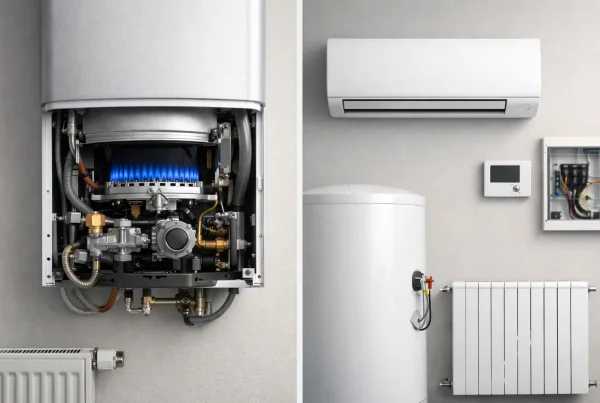
If you have a combi boiler, hot water is produced on demand. That means a fault can show up even if the heating seems to work. If you have a system or regular boiler with a hot water cylinder, the issue may sit with the cylinder thermostat, motorised valve or immersion setup rather than the boiler alone. That is why the right diagnosis matters.
Start with the simple checks
Before calling for help, it is worth ruling out the basics. These checks are quick, safe and often enough to spot the problem.
First, check whether the boiler has power. Look at the display, fused spur and consumer unit. A tripped switch or flat display can point to an electrical issue rather than a boiler breakdown. If the boiler has recently lost power, the clock or timer may also have reset.
Next, look at the boiler pressure gauge. Most domestic systems run properly around 1 to 1.5 bar when cold, though this varies slightly by model. If the pressure is very low, the boiler may lock out or fail to produce hot water properly. Some boilers can be re-pressurised using the filling loop, but only if you know how your system works and the manufacturer allows it. Overfilling the system is just as unhelpful as running it too low.
Then check the controls. Make sure the hot water is actually set to come on, especially if you have separate heating and hot water schedules. It sounds obvious, but after power cuts, clock changes or someone pressing the wrong button, this catches people out more often than you would think.
Finally, see whether the problem is with all hot taps or just one. If only one tap is affected, the issue may be local to that outlet rather than the boiler itself.
Common reasons your boiler has no hot water
Low pressure is one of the most common faults. If the system pressure drops too far, many boilers shut down to protect themselves. A one-off pressure loss may be easy to top up, but repeated pressure drops usually mean there is an underlying issue such as a leak, a faulty expansion vessel or a failing pressure relief component.
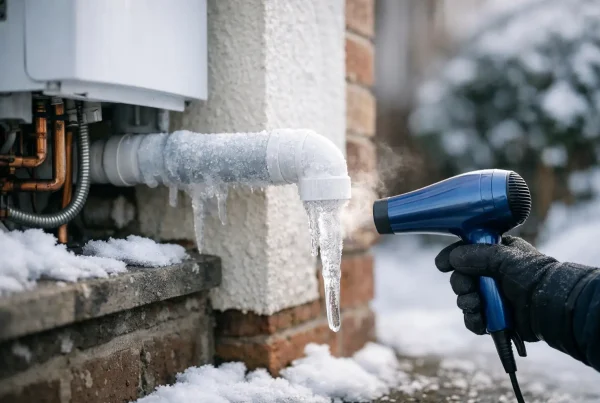
A frozen condensate pipe is another common winter problem. Modern condensing boilers send acidic waste water through a condensate pipe, often to an outside drain. In cold weather this pipe can freeze, causing the boiler to lock out. Sometimes the boiler shows an error code, sometimes it just stops working. If this happens during a cold spell, it is a likely culprit.
Diverter valve faults are common in combi boilers. The diverter valve directs hot water either to your radiators or to your taps. If it sticks or fails, you may get heating but no hot water, or the other way round. This is not a DIY repair. It needs proper testing and replacement if worn.
A faulty plate heat exchanger can also leave you with no hot water from boiler output, especially on combi systems. If it becomes blocked with sludge or limescale, the boiler may fire up but struggle to transfer heat into the domestic hot water supply. This can lead to lukewarm water, temperature swings or no usable hot water at all.
Thermistors and temperature sensors also fail. These parts tell the boiler what temperature the water is. If they give the wrong reading, the boiler may not heat water correctly or may cut out too soon. It is a small part, but it can make the whole system unreliable.
Pump problems, motorised valve faults and airlocks can all play a part too, particularly on older or more complex systems. In those cases, the boiler is not always the only problem. The wider heating setup needs checking as a whole.
What you can safely do yourself
There is a clear line between sensible checks and risky interference. Homeowners can safely check the display, controls, pressure reading and power supply. You can also check for obvious signs like a frozen external condensate pipe or whether the issue affects the whole house.
If your manual explains how to reset the boiler, a single reset may be reasonable. If it fires back up and works normally, keep an eye on it. If it locks out again, do not keep resetting it repeatedly. A boiler does not keep failing for no reason, and repeated resets can hide a fault that needs proper attention.
If pressure is low and you are confident using the filling loop, you may be able to top it up carefully to the correct range. If you are unsure, leave it alone. Too much pressure can trigger further faults or leaks.
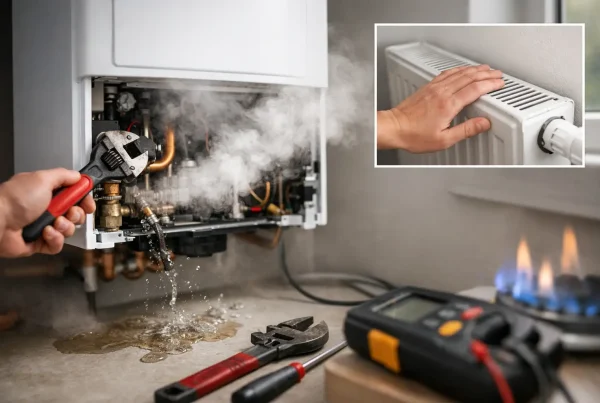
Beyond that, repairs are for a qualified Gas Safe engineer. Internal components, combustion checks, gas supply issues and electrical testing are not jobs to guess at.
When to call an engineer straight away
If there is no hot water and you can smell gas, switch off the gas supply if safe to do so, open windows, avoid using electrical switches and seek urgent help immediately. The same applies if you suspect a carbon monoxide issue, hear unusual banging from the boiler, or spot water leaking from the appliance.
You should also call for help if the boiler keeps locking out, pressure drops repeatedly, the error code persists, or the hot water cuts in and out. These are signs of an active fault, not a one-off blip. Waiting can turn a smaller repair into a bigger one.
For landlords, speed matters even more. A tenant without hot water is not just inconvenienced – it can quickly become a serious habitability issue, especially in colder weather or in homes with children.
Repair or replacement?
Not every no-hot-water fault means the boiler needs replacing. In many cases, a repair is the sensible option, especially if the boiler is otherwise in good condition and parts are still readily available. A failed sensor, valve or pump can often be sorted without major disruption.
That said, age matters. If the boiler is well over ten years old, has become unreliable, or needs repeated callouts, replacement may be more cost-effective over time. Older boilers can also be less efficient, so customers often end up paying twice – once in repair bills and again in higher running costs.
It depends on the fault, the age of the boiler and how often you have had trouble before. A good engineer should tell you plainly whether a repair is worth doing or whether you are better putting the money towards a new boiler.
How to reduce the chances of losing hot water again
The best way to avoid sudden hot water loss is regular servicing. A yearly boiler service helps pick up worn parts, poor combustion, pressure issues and early signs of failure before they turn into a breakdown. It also gives you confidence that the appliance is running safely.
System condition matters as well. Sludge, scale and poor circulation all put strain on a boiler. If radiators are slow to heat, cold in places or noisy, those signs should not be ignored. They often point to wider system issues that affect hot water performance too.
In winter, it also helps to protect vulnerable condensate pipework and deal with minor faults early. Boilers rarely choose a convenient time to break down.
When you have no hot water from boiler problems, the main thing is to act sensibly. Check the basics, do not take risks, and get proper help if the fault is not obvious. Fast diagnosis usually means a faster fix, less disruption and a safer home. If the problem is urgent and you need a dependable local engineer in Leeds, GasPlumb can help get your hot water back on without fuss.